There are many special things about the CNS (as you have seen in previous pages) but there is one more to go! The blood circulation and the lymph circulation.
2.
The blood circulation is of course crucial to our well-being and because our brains are so ‘delicate’, they need extra protection, even from the circulating blood!
3.
And, then, there is another surprise; there are NO lymphatic vessels in the CNS!
4.
That is weird! Isn’t the lymphatic system designed to remove waste products from the external fluid?
5.
Yes, that is true, but this is so crucial that another system has developed in the CNS; the glymphatic system; which we will (also) describe in this page.
As in other organs, the capillaries in the CNS are responsible for the transport of fluid and many molecules from the blood to the interstitial fluid and back.
2.
This is case for the transport of water, carbon dioxide, oxygen, and other lipid-soluble substances such as anesthetics and … alcohol (How NICE!),.
3
In fact, there is a huge amount of blood vessels, especially capillaries, in the brain tissue. The length of all the capillaries together is estimated to cover more than 500 miles!
4.
However, the delicate brain tissue must also be protected against noxious material that may be present in the circulating blood.
5.
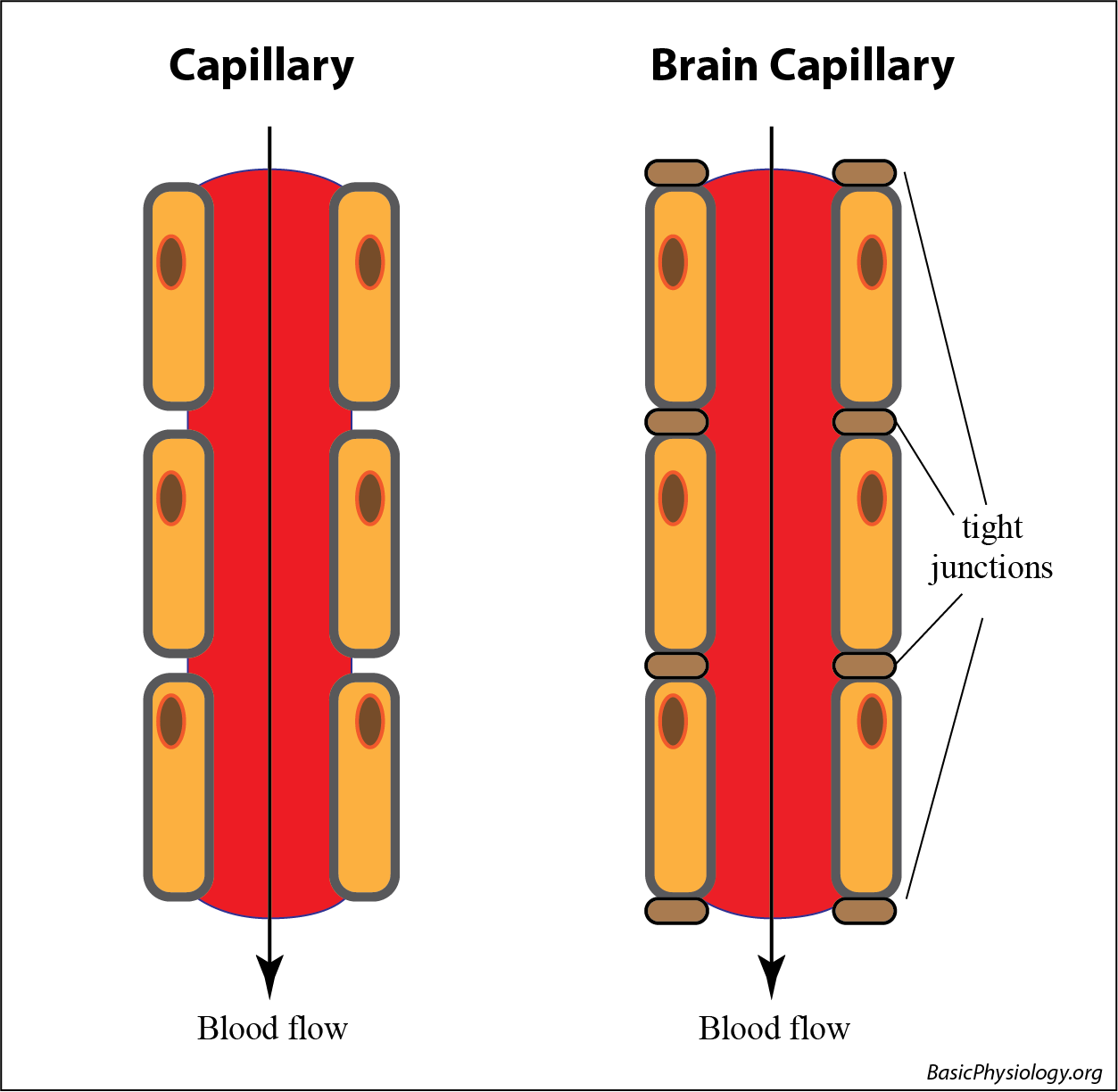
Therefore, the capillaries are NOT permeable to plasma proteins and other large molecules, such as therapeutic drugs. This non-permeability is called Blood Brain Barrier!
6.
As you can see in the diagram, the boundary of the capillaries between the blood and the interstitium, which is readily accessible in normal tissue, is firmly closed by tight junctions in the brain; hence the name Blood-Brain-Barrier!
7.
Because of this barrier, only the most essential nutrients are allowed to leave the blood capillaries.
These essentials are of course the gasses (oxygen and carbon dioxide), and fat-soluble molecules.
8.
In addition, there are also several transport systems available, for example to transport glucose into the brain.
9.
Unfortunately, this barrier also makes it difficult or impossible to provide medical treatment such as anti-microbrial drugs to the brain.
But we are still facing the problem of the lack of lymph vessels in the brain. How does the brain get rid of waste products etc?
2.
Breaking news! There is after all, a lymphatic system in the brain but, in several aspects, quite different from that in other organs.
3.
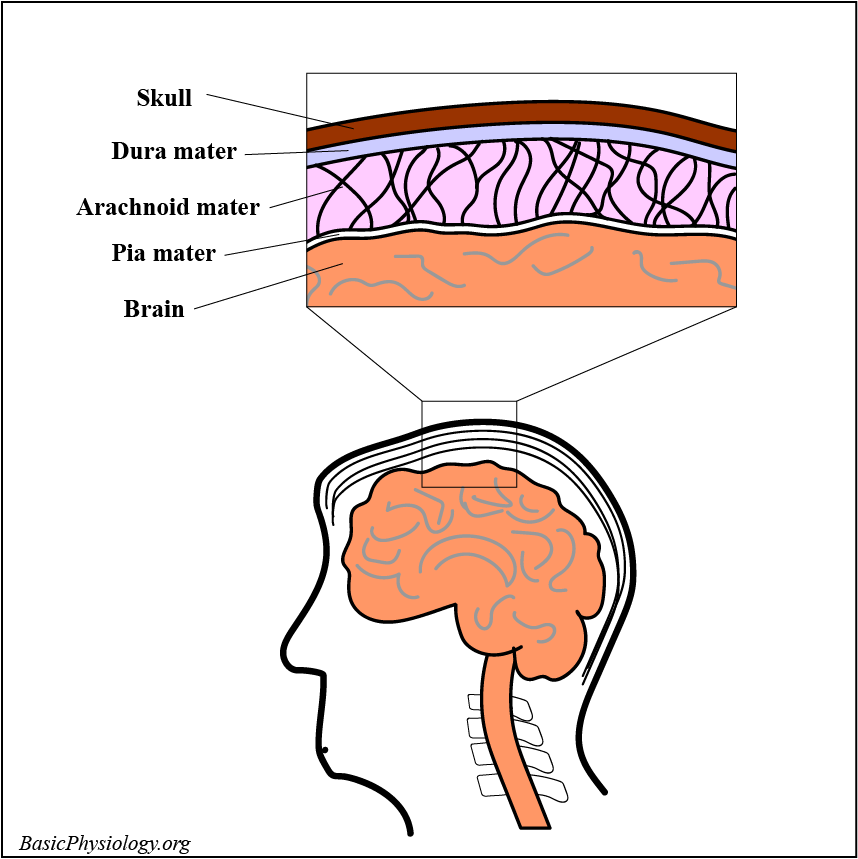
There are lymph vessels that are located, together with the arteries, the veins and nerves, in the arachnoid space. This arachnoid space is located between the dura mater and the pia mater, just below the skull:
4.
Together, these layers form the meninges:
Dura mater (outer layer)
Arachnoid mater (middle layer)
Pia Mater (inner layer)
Btw, ‘mater’ is Latin for ‘mother’!
5.
But below the meninges, in the brain, there are arteries, veins and plenty of nerves, but no lymph vessels!
6.
In the interstitial space, between the neurons, there is still fluid streaming from the capillaries into the interstitial space, to provide oxygen etc. and streaming back to the capillaries to remove CO2 etc.
7.
But what about those waste products that do not make it back to the capillaries and that, in other tissues, are removed by the lymph vessels?
8.
This is where a new system comes in, new because this was recently discovered but, of course, has been there for millions of years!
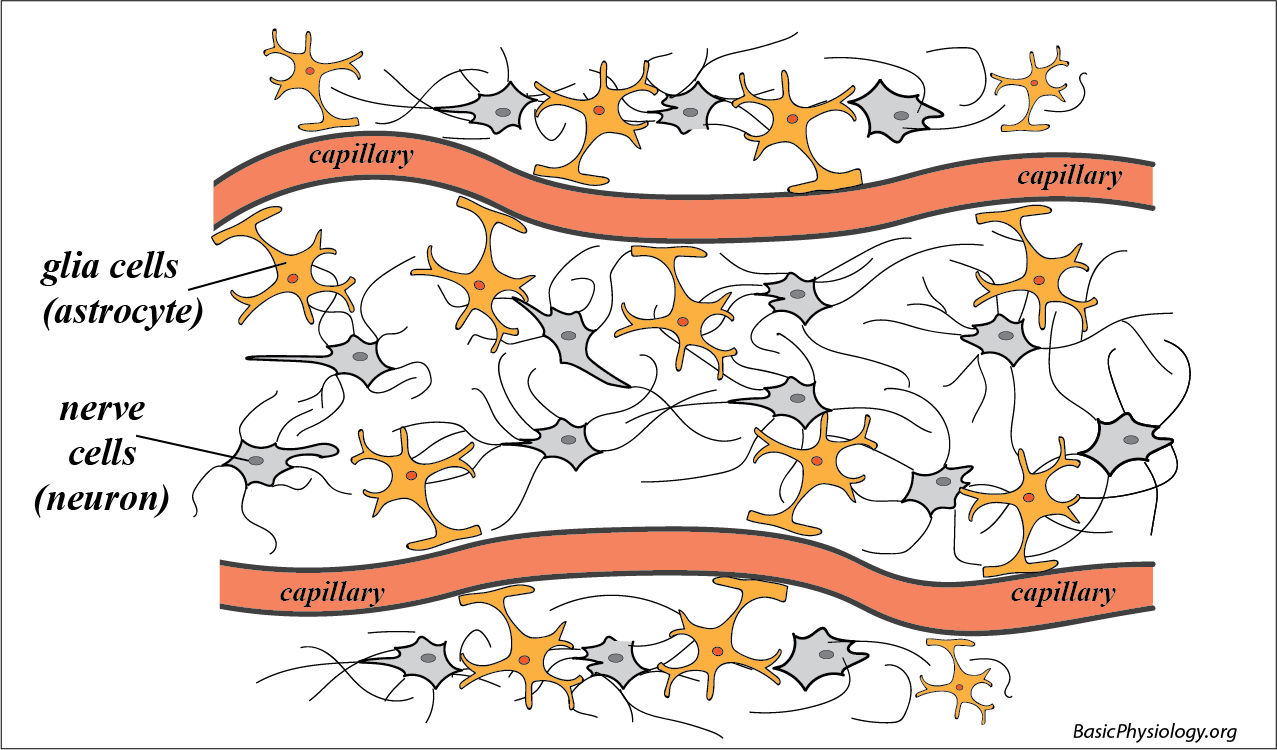
This diagram displays the architecture of the tissue located in the brain between the capillaries. As you can see, there are capillaries and many nerve cells.
But interestingly, there is also another cell type prominently present; the glia cells (also called astrocytes).
2.
And, as “promised”, there are no lymph vessels.
3.
The current concept of the glymphatic system is that instead of the lymph vessels, there are glia cells that take care of the removal of waste products from the interstitial space.
4.
It is not yet fully clear how that is done but one hint can already be seen in this picture; the fact that many glia cells seem to have a ‘foot’ that is located close to a capillary membrane.
5.
Recently, an ion channel was found in these “feet” which, when these channels were blocked, led to local interstitial swelling. In other words, the glia cells together with these channels in some ways are responsible for the removal of extra fluid and waste products from the brain tissue.
6.
Interestingly, this glymphatic system has only been discovered/described in recent years. When I started studying physiology (some ±40 years ago; 😆) no one knew anything about this system!
7.
However, it must be clear that this is a developing ‘story’ and that many laboratories around the world are now working hard to solve this interesting problem!
8.
And, oh yes, why has this new system been called “glymphatic”? Because this word is a junction of “glia” and “lymph”!