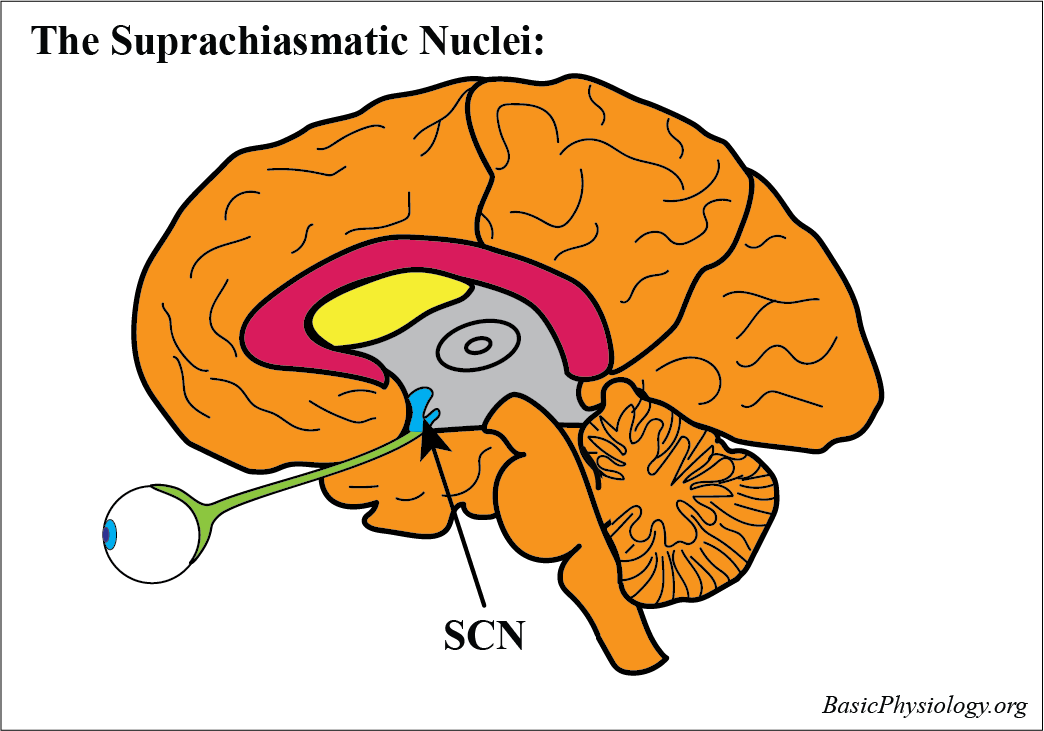
Oh yes! There is also a “Biological Clock” in our body.
2.
Actually, there are many ticking clocks in our body, essentially in all our organs, tissues and cells. They regulate all kind of rhythms, sleep, hormones, fertility etc.
3.
But there is one that takes the lead; the biological clock located in the brain, also called the Master Clock.
4.
This ‘master’ clock consists of a relatively small group of nerve cells, located in the suprachiasmatic nucleus (SCN).
This master clock imposes a rhythm on our body. This rhythm is also called ‘circadian’, which means daily rhythm (‘circa’ = ‘about’ and ‘dies’ = “day”).
2.
As determined by the fact that we live on earth that rotates every 24 hours in front of the sun, this circadian rhythm is 24 hours long and imposes a 24-hour rhythm on the earth, on all its living organisms and on our body functions.
3.
These body functions are, amongst others:
Sleep patterns
Hormonal release
Appetite and digestion
Body temperature
4.
Sleep patterns; we all know that, at the end of the day, we will fall asleep. This is determined by the rhythm of the daylight. And, of course, it is disturbed when we fly around the world to a different time zone.
5.
From this, it is obvious that signals from the eye, which registers the presence or absence of daylight, will inform the brain centre (SCN) on the situation outside the body.
6.
Btw, what would happen is the earth did not rotate every 24 hours but faster (10 hours?) or slower (100 hours?)?
But we also have other clocks in our body with different rhythms!
2.
The most ‘famous’ clock is of course the heartbeat. Normally the heart beats at about 60-70 cycles per minute but this may increase to higher frequencies if the heart is stimulated by exercise or tension or decrease at a slower rate (when we sleep).
3.
And then we have the respiration rate, somewhat slower than the heart, the frequency of which is also determined by stress, exercise etc.
4.
And … we also have clocks that work ‘slower’ than the circadian rhythm.
The most obvious one is of course the menstrual cycle in woman, and the slowest of all is … aging!
5.
Other rhythms which we often forget, are those in the digestive system (the stomach, the small and the large intestines), all with their own clocks and rhythms.
6.
Even at the (sub) organ levels, we can detect rhythms, even in single isolated cells, at least those with a nucleus (eukaryotic cells).
7.
Eukaryotic (cells with a nucleus) show rhythmic cellular activities whereas prokaryotic cells (who do not have a nucleus and therefore no DNA) do not show any rhythmic pattern. In other words, the cellular clock is located in the DNA!
We, humans, know what a nigh shift is; people who have to work at night; nurses, doctors, police man, fireman (and woman!), etc.
2.
And we know that, after a few night shifts, it takes several days to get back to a normal circadian rhythm and daily life.
3.
And …. nobody likes night shifts; shifting back to normal daily life, upset stomachs, diarrhoea, etc.
4.
Furthermore, it has been shown that chronic nightshifts, in time, also may induce serious diseases, such as diabetes, obesity, heart diseases, mental health issues, etc. NOT nice!
5.
I am writing this because I recently read in a paper that it makes more sense to program the night shifts into two separate time shifts.
6.
Instead of one shift (from 11 pm till 7 am), it makes more sense to have a first shift (8 pm till 4 am) and another person do the second shift (from 4 am till 12 am).
7.
People that have been subjected to this new ‘chrono shift’, experience much less discomfort and get back to normal daily life much faster. Nice to know!